Why are students reluctant to build their learning portfolio ?
As a design and multimedia student, I got my idea about what is a portfolio but a learning portfolio is different. That's why the first step to enter in the project was to understand: what is a learning portfolio? Why teachers encourage students to build one? What are its benefits? and why are the student reluctant to build one?
The Problem
After learning more information about the learning portfolio, the two other students and I decided to interview some students to understand why they don't manage or don't want to create a learning portfolio?
Interview answers
- Most of the students answered that they don't understand the benefits of the learning portfolio
- Some students don't know how to prove their skills
- Most of the students create a learning portfolio because it's required for graduate
We conclude that as most students don't understand the benefit of the learning portfolio, they do it at the last minutes and only for the grade. Nevertheless, doing it at the last moment doesn't allow them to collect proofs of their experiences and to reflect on them. That's why most of the learning portfolio is bad.
Proto-persona
Pierre Dupont is a student in civil engineering at the Paris-Est Engineer School. He is 21 and lives alone on the campus. He's a member of the humanitarian association "L'as de Coeur" and participates actively in the actions. He likes also sport and video games. He will be soon graduate and work hard to get a good overall GPA. Like most of his generation, he has several social media accounts and spends a lot of time on the internet.
Our first idea was to create an online phone game. With this, students could play and understand the principles of the learning Portfolio from anywhere on their phone. Nevertheless, we left this idea really fast. Indeed, as students don't understand the benefit, we thought that they will not make the step to learn about it on their own. Instead, they should be guided by a professor who can answer their questions and tell them the benefit. So we conclude that a boardgame leading by a teacher as a game master will be a better option.
The process
The game design journey has begun in November 2018 with a game jam organized by Reine Nguo-Ngue. She invited all the team but also other students. During this game jam, we have created different prototypes that were focused on a different stage of making a portfolio. We have separated the process of building a learning portfolio in two steps. The first one is collecting prints / prooves. The second one is to assemble these prints and to reflect on them to demonstrate skills. At the end of the game jam, we end up with two prototypes, one for each step. The game for the first step was a card game based on deck-building mechanism. We begin the game with 5 'Time' cards which allow us to buy 'proofs of experiences'. We have later left this game because it was not fun to play. Indeed, it was to close the reality and also the lack of interaction between the player. The second game consited to assemble different cards to make the other players guess which skills did I own based the prooves that I show. At this time, this game had a lot of problems but we had see in it a potential. This event allow us to have an idea of what kind of game mechanism could work and which one will not work.
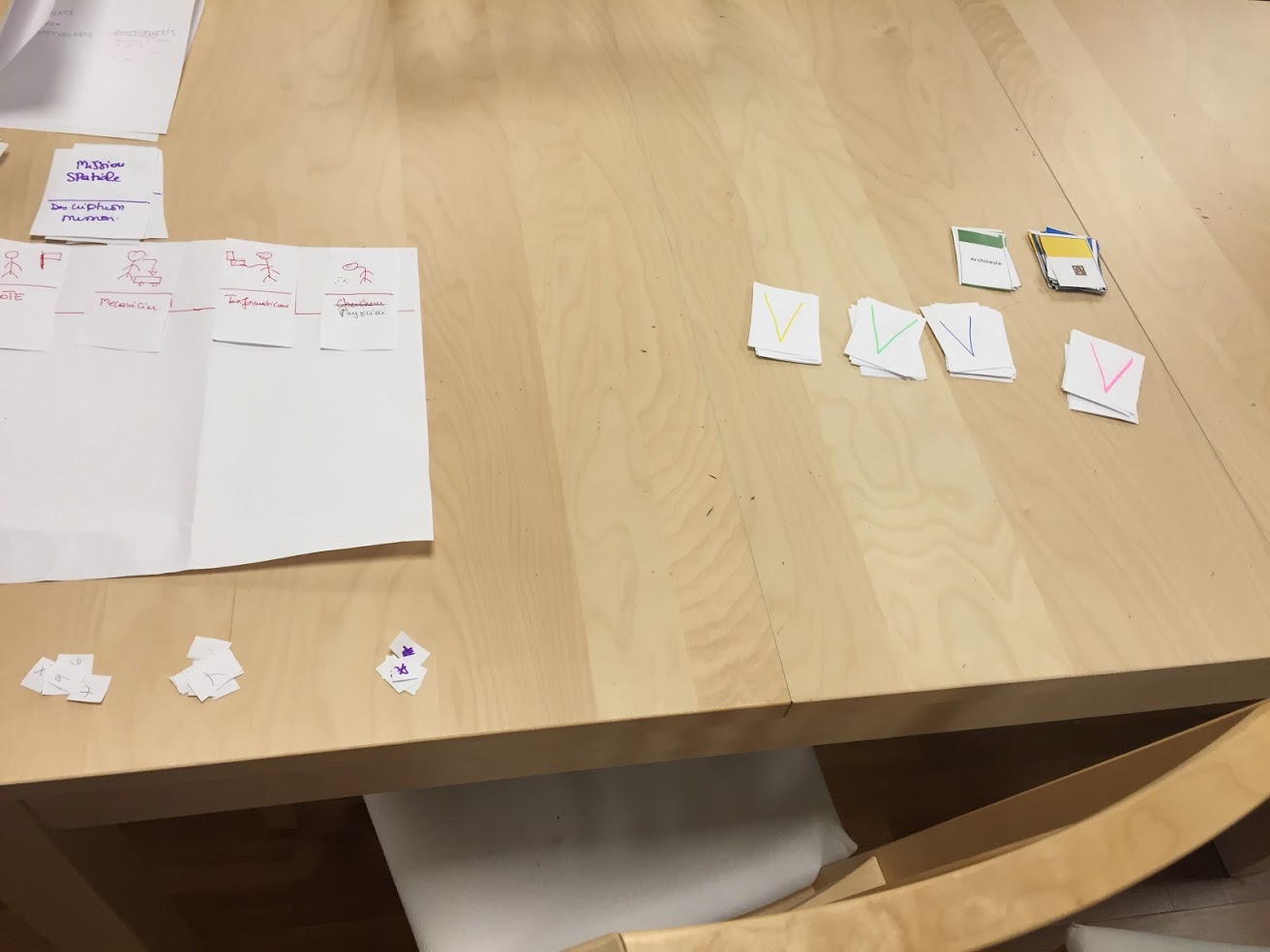
Exemple of prototype creating during this game jam
After this game jam, we decided to work on the second prototype realized. The wanted message behind this game is: To demonstrate skills, you need to show several relevant prooves. But it's not because the number of proves is high that the skill is well demonstrated. Indeed, show one relevant and good workpiece is better than hundreds of bad works. The biggest choice that we made was to make the game more abstract. We decided to avoid the terms 'proofs' and 'skills' which were to close the learning portfolio universe. This choice allows us to create a new universe around the game, which will bring more fun to the game. But one of our fear was the loss of the message. To be sure that our games go in a good direction, we prototype and test our game as often as possible.>
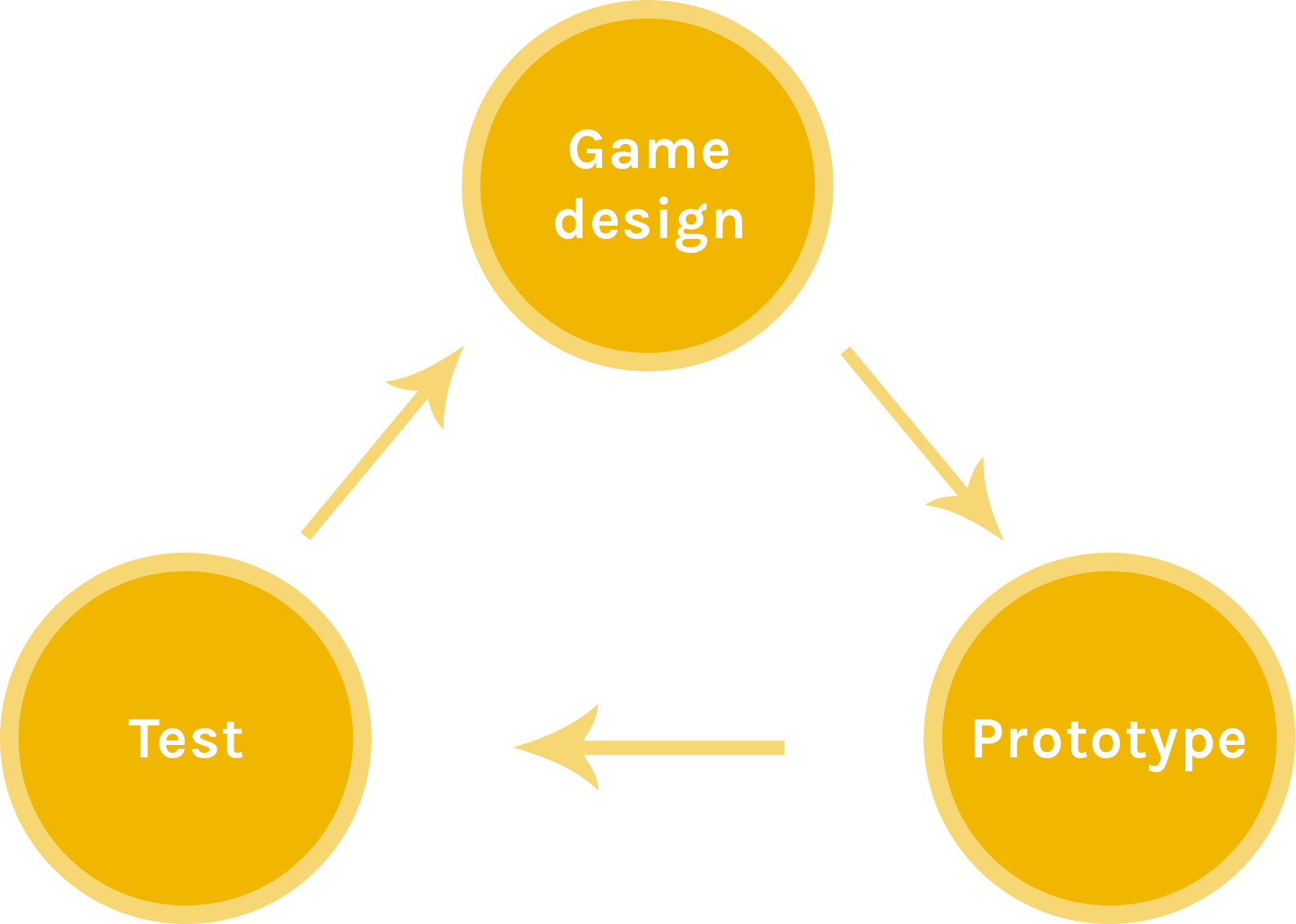
In January, we got the rule of Vestigium. At this time my role change, I was now in charge to create the illustration of the game. During one week, I have created nearly 20 cards. It was not enough to play but as our game relies a lot on illustration, we had to test the new card to know on which direction I should go and which cards needed improvement. During the test, we watch people play and we saw fast that the game seems to easy. Indeed, the cards were not abstract enough. At the end we asked to the players, what message do they pull out from the game and good news, they understand without any guidance the message that we want to deliver : " if we show the good combination of images, we find the word but one wrong images can change the understanding".

Exemple of card modification after a test phase
At the beginning of february, we got our first finish prototypes. Behind, you can see a sample of cards that I have realised using photoshop.



The results
Today, it's to soon the see the impact of the game on the student portfolio because the game as only be tested on few voluntary students. Futhermore, the project is not finished yet. Indeed, an other game 'Skandal' is still in development.
If you want to know more about the project, Axel, Marco and me have made a video about the Klap project.